The high-performance computer "Dawning 6000," which will have a computing speed over 1,000 trillion operations per second, will adopt the Chinese-made general processor Loongson for the first time as its core component. This is according to the Dawning Information Industry Company.
"Dawning 6000" is currently jointly developed by the Institute of Computing Technology under the Chinese Academy of Sciences and the Dawning Information Industry Company.
Li Guojie, chairman of Dawning Information Industry Company and director and academician of the Institute of Computing Technology, said research and development of the Dawning 6000 is expected to be completed in two years. By then, Chinese-made high-performance computers will achieve two major breakthroughs: first, adopting domestic-made central processing units (CPUs) will be technically obstacle-free; second, the existing cluster-based system structure of high-performance computers will be changed once the computing speed reaches 1,000 trillion operations per second.
Resource - People’s Daily Online
Wednesday, December 3, 2008

In Courtroom Showdown, Bush Demands Amnesty for Spying Telecoms

SAN FRANCISCO — The Bush administration on Tuesday will try to convince a federal judge to let stand a law granting retroactive legal immunity to the nation's telecoms, which are accused of transmitting Americans' private communications to the National Security Agency without warrants.
At issue in the high-stakes showdown — set to begin at 10:00 a.m. PST — are the nearly four dozen lawsuits filed by civil liberties groups and class action attorneys against AT&T, Verizon, MCI, Sprint and other carriers who allegedly cooperated with the Bush administration's domestic surveillance program in the years following the Sept. 11 terror attacks. The lawsuits claim the cooperation violated federal wiretapping laws and the Constitution.
In July, as part of a wider domestic spying bill, Congress voted to kill the lawsuits and grant retroactive amnesty to any phone companies that helped with the surveillance; President-elect Barack Obama was among those who voted for the law in the Senate. On Tuesday, lawyers with the Electronic Frontier Foundation are set to urge the federal judge overseeing those lawsuits to reject immunity as unconstitutional. At stake, they say, is the very principle of the rule of law in America.
"I think it does set a very frightening precedent that it's okay for people to break the law because they can just have Congress bail them out later," says EFF legal director Cindy Cohn. "It's very troubling."
The judge presiding over the case, U.S. District Judge Vaughn Walker of San Francisco, announced late Monday he wanted to discuss 11 questions (.pdf) at Tuesday's hearing, one of which goes directly to the heart of the immunity legislation.
"Is there any precedent for this type of enactment that is analogous in all of these respects: retroactivity; immunity for constitutional violations; and delegation of broad discretion to the executive branch to determine whether to invoke the provision?," the judge asked.
Carl Tobias, a professor at the University of Richmond School of Law, says the immunity legislation, if upheld, "makes it possible to extend immunity to other areas of the law."
He agreed, for example, that it would not be far-fetched to imagine Congress immunizing ExxonMobil for the 1989 Valdez oil spill "for national security reasons." A jury awarded about $5 billion in punitive damages in that case, an amount the courts reduced to $500 million.
In the telecom immunity challenge, the government argues that the telecoms should not be punished, or suffer the threat of punishment, for a surveillance program that the Bush administration claims was designed only to fight terrorism. The government also denies the lawsuits' allegations that the surveillance was a broad dragnet that sucked down Americans' communications on a wholesale basis.
The administration also says the immunity is warranted because the lawsuits threaten to expose government secrets.
The EFF brought the original spying lawsuit in 2006 against AT&T, and has since been joined by dozens of others targeting the nation's telecommunications companies.
The EFF's case, which has been consolidated with the others in the U.S. District Court of San Francisco, includes so-called whistle-blower documents from a former AT&T technician. The EFF claims the documents describe a secret room in an AT&T building in San Francisco that is wired to share raw internet traffic with the NSA.
The government sought to dismiss the original EFF case, and others that followed, on the grounds that they threatened to expose state secrets. Judge Walker has ruled against the government, saying the case could proceed.
The government appealed. But before the appeal was decided, Congress on July 9 gave the president the power to grant immunity to the carriers.
The EFF is now challenging the immunity legislation on the grounds that it seeks to circumvent the Constitution's separation of powers clause, as well as Americans' Fourth Amendment rights against unreasonable searches and seizures.
"The legislation is an attempt to give the president the authority to terminate claims that the president has violated the people's Fourth Amendment rights," the EFF's Cohn says. "You can't do that."
Two weeks ago, the administration told Walker in a court filing (.pdf) that the immunity legislation "represents the considered judgment of our nation's political branches that, in the unique historical circumstances following the 9/11 attacks, telecommunications companies should not bear the burden of defending against claims that those companies assisted the government in its efforts to detect and prevent further terrorist attacks."
Congress, the government continued, "concluded that those companies should not face further litigation if they provided such assistance pursuant to a court order or a written certification, directive or request from a senior government official, or did not provide the alleged assistance."
The immunity law allows the government to file a classified brief with Judge Walker activating immunity for a particular communication company. Walker then has little power to deny the request, unless the judge finds the immunity legislation is itself unconstitutional.
Oral arguments in Walker's courtroom are scheduled for 10 a.m. PST on Tuesday. Threat Level will cover the proceedings live.
Resource - Wired
More Rumours of a Nokia Laptop Computer
Rumours that Nokia may start production of its own brand laptop computers have resurfaced after UBS analyst Maynard Um issued a research note saying that it was increasingly likely to happen 


Nokia MikroMikko 1 (credit Mika Ojutkangas)

Ericsson Portable PC (credit Datasalen)
"Given the rise of net-books/dongles sales, convergence between high-end mobile phones and laptops, and forays by computer manufacturers (Apple, HP) into smartphones, we think it is only a matter of time before Nokia launches notebook type devices,” Um wrote in the note - warning that they he does not expect a product to hit the shops until Q3 2009 at the earliest.
"Our checks indicate Nokia may be working on a 9”-10” notebook/tablet PC with a second OLED display, touchpad, near field communication (NFC) capability, HDMI out, and Linux OS. Given its seemingly higher end functionality, we do not think it will compete in the traditional netbook (~US$400) market."
There were rumours around April this year that Nokia was looking at launching a range of computers - but this was firmly refuted at the time by Nokia’s global marketing VP, Anssi Vanjoki.
Vanjoki said: "I have heard the rumours and I can categorically say Nokia is not entering the laptop market." Although Apple is known for selling laptop computers, Vanjoki said: "They sell some Notebooks, but the growth is from iPods. I don’t think they’re having commercial success with Notebooks."
It is worth noting though that Nokia sold computers in the past.
In the mid 1980's Nokia had a PC division, and merged it with Ericsson Information Systems, whose origins lay in the purchase by Ericsson of the computer business of Saab. The merged company, Nokia Data was later sold to UK based ICL in 1991 - and later became part of the larger Fujitsu group.
Nokia Data's most notable computer was the MikroMikko 1 - which was sold around the world.
Ericsson for its part sold mainly IBM compatible computers - and even launched a laptop (by the standards of the time) in 1985.
Resource - cellular-newsAmazon's database service enters public testing


SimpleDB, one of Amazon.com's suite of online services that people can use to build Web sites or other computing operations, is out of private beta testing.
The service lets programmers store database records at Amazon and extract specific data from them. Along with the shift to public beta testing, Amazon cut the price for storing data from $1.50 to 25 cents per gigabyte per month.
SimpleDB, introduced nearly a year ago, is a newer arrival into the Amazon Web Services suite. Other services let customers process data, store raw data, distribute content, and store messages sent among different computers.
The company also announced basic level of use is free for at least six months--the first time the company has done so with one of its Web services. After various thresholds are met in data transfer and computer processing, customers must pay according to usage.
"We've made the business decision to go with SimpleDB even simpler than it was before. You can now get started for free. For at least the next six months, you can consume up to 500MB of storage, and you can use up to 25 machine-hours each month. You can transfer 1GB of data in, and another 1GB out," said AWS evangelist Jeff Barr in a blog posting Monday.
Among those using SimpleDB are Pluribo, Issuu, and MyMiniLife.com, Amazon said.
To make SimpleDB easier to use, Amazon said it plans to release a new interface similar to the SQL (Structured Query Language) widely used in databases today. It also plans a mechanism to let people more easily upload multiple items.
BenQ Joybook U101 launches, gives almost no joy
M
The BenQ Joybook Lite U101 we spied back when it was announced in September has just launched, and though there's nothing incredibly exciting here, we thought we'd give you a quick rundown, because we're just cool like that. The U101 boasts completely standard netbook fair -- an Atom N270 CPU, Intel 945GSE chipset, 1GB of DDR2 memory, with 80-160GB mechanical drives and 4-16GB SSD options. It's also got a 16:9 display with a 1024 x 576 resolution (rare for a netbook), a 1.3 megapixel webcam, and three USB 2.0 ports. The sassy little number comes in blue, pink, white and black, and it can be yours for €398 ($503) in Taiwan right now, but we've got no word on when it will be available elsewhere. Dip this puppy in gold or something and then maybe, just maybe we'll bite.
Resource - Engadget
The BenQ Joybook Lite U101 we spied back when it was announced in September has just launched, and though there's nothing incredibly exciting here, we thought we'd give you a quick rundown, because we're just cool like that. The U101 boasts completely standard netbook fair -- an Atom N270 CPU, Intel 945GSE chipset, 1GB of DDR2 memory, with 80-160GB mechanical drives and 4-16GB SSD options. It's also got a 16:9 display with a 1024 x 576 resolution (rare for a netbook), a 1.3 megapixel webcam, and three USB 2.0 ports. The sassy little number comes in blue, pink, white and black, and it can be yours for €398 ($503) in Taiwan right now, but we've got no word on when it will be available elsewhere. Dip this puppy in gold or something and then maybe, just maybe we'll bite.
Resource - Engadget
Firefox Surpassing 50% Market Share in More Regions
On top of today’s exceptional news about Firefox surpassing 20% worldwide market share during the month of November, we have further good news to share. After Firefox reached the 50% market share milestone in Indonesia back in July, we can now say the same about two more regions: Slovenia and Macedonia. Below you’ll find the November 2008 numbers according to Net Applications.
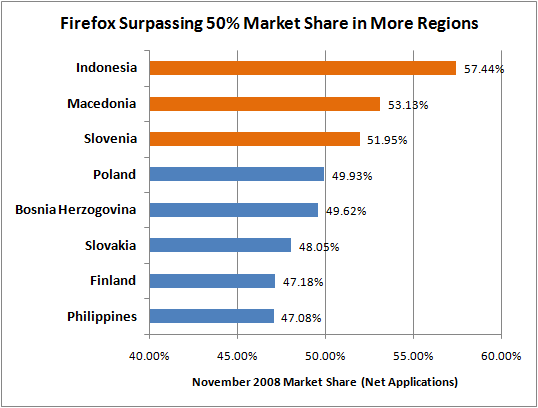
What’s the key takeaway here?
Our market share in the regions above has been growing like crazy. For example, since our July announcement about Indonesia, we’ve seen Firefox’s share in Indonesia pick up another 7%, Slovenia 4%, Slovakia 5%, and the Philippines an astounding 13%!
A tremendous amount of credit here goes to the Mozilla community. John Lilly summed it up best: “The open web is more vibrant than ever, and the thousands of Mozilla contributors around the world have played a major role in making it that way.”
Obama-Biden transition site Change.gov now under a Creative Commons license

Change.gov, the website of US president-elect Barack Obama’s transition team, has undergone some important and exciting changes over the past few days. Among them is the site’s new copyright notice, which expresses that the bulk of Change.gov is published under the most permissive of Creative Commons copyright licenses - CC BY.
Except where otherwise noted, content on this site is licensed under a Creative Commons Attribution 3.0 License. Content includes all materials posted by the Obama-Biden Transition project. Visitors to this website agree to grant a non-exclusive, irrevocable, royalty-free license to the rest of the world for their submissions to Change.gov under the Creative Commons Attribution 3.0 License.
This is great news and a encouraging sign that the new administration has a clear sense of the importance of openness in government and on the web (there’s a bit more on this over at Lessig’s blog). The embrace of Creative Commons licensing on Change.gov is consistent with earlier support by both Obama and McCain for the idea of “open debates.” (It’s also in line with Obama’s decision to publish the pictures in his Flickr Photostream under a Creative Commons BY-NC-SA license - pretty cool!)
Tim O’Reilly has written a smart post (which has elicited some very thoughtful reader comments) recommending that Change.gov use revision control as a way to further improve transparency and make it possible for the public to review any changes that occur on the site. Of course, licensing is just one component of openness, but getting licensing right is necessary for enabling people to truly take advantage of technologies that facilitate collaboration.
Update: Several people have pointed out that “works created by an agency of the United States government are public domain at the moment of creation” (see Wikipedia for more on this). Change.gov is not currently the project of a government agency, but a 501(c)(4) that has been set up to manage the Obama-Biden transition. Also, the public is being invited to contribute their own comments and works to the site, and it is important to have a clear marking of the permissions that other people have to this material.
Resource - Creative Commons
Subscribe to:
Posts (Atom)

 Posts
Posts


